Posts

Ocean going capabilities for Russian frigates
Image
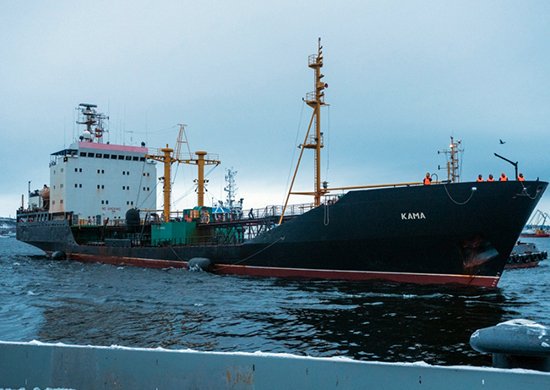
Northern Fleet frigate RFS Admiral Gorshov recently conducted a Replenishment at Sea (RAS) on the Atlantic Ocean. The RFS Gorshkov and her escorting group were transiting from Cuba towards her home base when the RAS took place. RAS is not considered to be a special maneuver and is a common practice for warships who operate for extended periods at sea. RAS allows warships to extend their duration at sea by taking on supplies from logistic vessels. During this operation, the RFS Gorshkov and her escorting ships took on fuel from the sea tanker RFS Kama. Northern Fleet light tanker RFS Kama Russian shipbuilding programs are currently focused on the construction of smaller warships such as frigates and corvettes. The smaller displacement of these warships also restricts the space available to store supplies such as food and fuel, lowering the time these ships can spend at sea. The only way these ships can extend their operational endurance at sea without returning back to port is ...

New destroyers for the Russian Navy?

Image
Russian news outlets reported on Thursday May 9 the existence of plans to build a new variant of the Project 22350 Admiral Gorshkov class frigates which are currently in service in the Russian Navy. The new variant is to increase in size to a water displacement of 7.000 tons, compared to the 4.500 tons of the current Admiral Gorshkov class. At the same time, the amount of missile launchers on board of the new variant is to increase to a total of 48 Vertical Launch System (VLS) cells, a significant increase compared to the current modern frigates that Russia is building. According to Russian media outlets, a total of 12 ships of this new variant are to be constructed with the first ship entering service in 2027. A finalization of the contract is expect by the end of 2019. Project 22350, commonly known as the Admiral Gorshkov class, is one of the few modern classes of frigates that Russia is currently building. The lead ship, RFS Admiral Gorshkov, has proven itself to be a capable f...

Russia's newest minehunters in perspective

Image
Russia recently announced that it also seeks to modernize its mine countermeasure (MCM) fleet which resulted in a shipbuilding plan for around 40 new minesweepers to join the Russian fleets by 2030. This new shipbuilding program will result in a further modernization and  increase in efficiency with regard to Russian MCM operations, it will not result in a closing of the capability gap that currently exists compared to western naval forces. Russian media outlets stressed the fact that the new minesweepers will be constructed with a plastic hull instead of regular hulls which are typically made of steel or wood. While Russian sources were quick to report on this they did not mentioned that the shift towards plastic hulls is done due to its bigger advantages while conducting MCM operations. Due to their plastic hulls, the new Russian minesweepers will be able to reduce their magnetic signature, making them less detectable by magnetic mines. The decision to use these new hulls is...

Russia's naval priorities exposed?

Image
Construction of the Project 636.3 Improved Kilo class diesel-electric submarines continues at a steady pace. Following the construction of a batch of six submarines for the Black Sea Fleet, Russian news outlets reported that a second batch of submarines was starting construction. At least four new submarines were mentioned by the media with the first two submarines, the Petropavlovsk-Kamchatsky and Volkhov, destined for the Russian Pacific Fleet. Type 636.3 submarine The construction of these submarines, currently the most modern in diesel-electric submarines in the Russian Navy, offers us a small albeit incomplete insight in the naval modernization plans and priorities of the Russian Navy. The current state of the Russian Navy is slowly changing from an outdated fleet in decline to a modern green water navy capable of projecting military power in the near seas. Russia's naval modernization is currently ongoing and a lot of ships are in need of replacement in order to st...

Airborne troops conduct amphibious landing at Crimea

Image
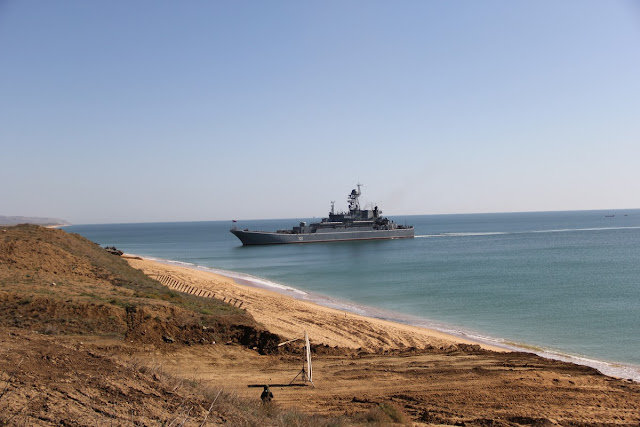
Units belonging to the 7th Guards Mountain Air Assault Division conducted an amphibious landing on the Opuk training ground at the Crimean Peninsula. The exercise was part of larger military maneuvers held by Russian airborne forces on the peninsula over the previous days. The fact that airborne units were used in a task which is traditionally assigned to Russian Naval Infantry suggests that Russia tested the interoperability of its ground forces against an enemy attack upon the Crimea Peninsula.  RFS Ceasar Kunikov approaching the Opuk training ground Around 400 airborne troops, supported by over 30 military vehicles, were transported to the Opuk training ground by two landing tank ships. Russian media identified these ships as the RFS Ceasar Kunikov and the RFS Azov. Both vessels are part of the Ropucha-class LST's, each capable of transporting up to 340 soldiers and a dozen armored vehicles. Following the initial landing operation, both ships conducted gunnery exercis...

Russia sets to improve the Ivan Gren-class

Image
Russia recently announced that it plans to build two more Ivan Gren-class ships for its navy. Both ships are reported to be upgraded versions of the current RFS Ivan Gren, the sole ship of its class. The upgrades were not specified but are to be made in the fields of ship maneuverability, readiness during sea transit, crew habitability and the ergonomics of the ship. RFS Ivan Gren Landing Ship Tank Though details of the upgrades are unknown, the identified fields give us an insight of the next two Russian amphibious assault ships. First, there is no evidence to suggest that the Ivan Gren-class will undergo significant structural changes. The ship is designed to be a landing tank ship capable of carrying 13 main battle tanks or 36 armored personnel carriers and transport around 300 marines. The transport capacity and her capabilities of landing these troops (through beaching herself and opening her bow doors) are expected to remain. The upgrades are more to be expected to...

Russia reinforces Baltic positions with new troops

Image
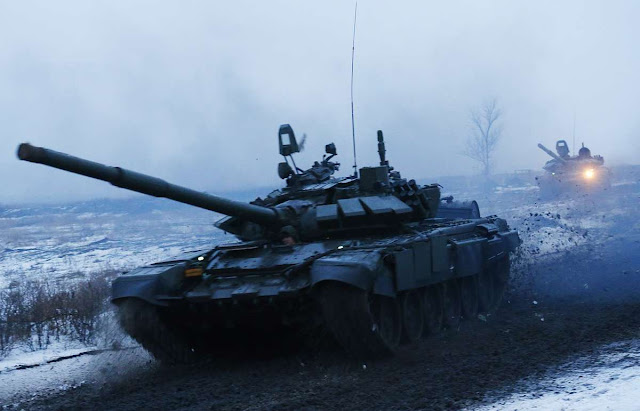
Russia announced on Wednesday February 27 that it will set up a tank regiment and a coastal defense missile battalion in the Baltic region. The deployment is scheduled to be completed in 2019 but no specific time frame was brought forward. Both military formations are to be attached to the Russian Baltic Fleet. Although the location of the deployment was not mentioned by name, it is expected that both military formations will be stationed in the Kaliningrad Region. By stationing these formations in the Kaliningrad Region, Russia further strengthens its position in the Baltic Region. Kaliningrad is geographically isolated from the Russian mainland and effectively surrounded by NATO forces. The increasing in military formations in the Baltic Region allows Russia to defend its positions in this region to a higher degree. At the same time, the deployment follows the pattern of Russia using the Kaliningrad Region as a heavily defended bastion in the same way the Soviet Union defe...