Posts

Russia reinforces Baltic positions with new troops
Image
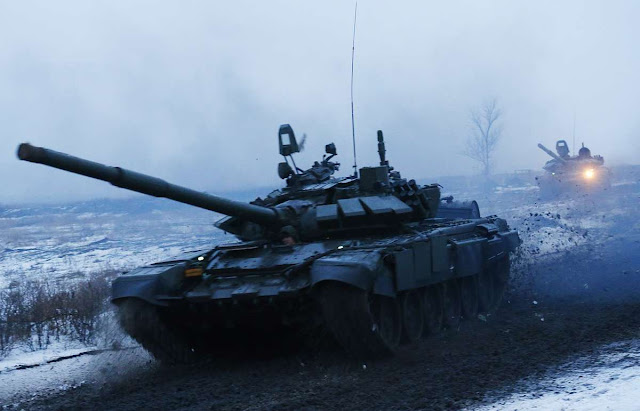
Russia announced on Wednesday February 27 that it will set up a tank regiment and a coastal defense missile battalion in the Baltic region. The deployment is scheduled to be completed in 2019 but no specific time frame was brought forward. Both military formations are to be attached to the Russian Baltic Fleet. Although the location of the deployment was not mentioned by name, it is expected that both military formations will be stationed in the Kaliningrad Region. By stationing these formations in the Kaliningrad Region, Russia further strengthens its position in the Baltic Region. Kaliningrad is geographically isolated from the Russian mainland and effectively surrounded by NATO forces. The increasing in military formations in the Baltic Region allows Russia to defend its positions in this region to a higher degree. At the same time, the deployment follows the pattern of Russia using the Kaliningrad Region as a heavily defended bastion in the same way the Soviet Union defe...
Baltic Fleet Aviation conducts training at Kaliningrad

Image
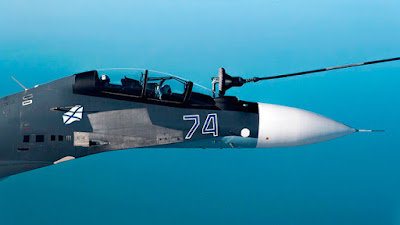
Aircraft of the Baltic Fleet conducted air training operations in the Kaliningrad Region on Tuesday February 29. The training was conducted by by Su-30SM and Su-24M aircraft and involved training in air to air refueling from a IL-78 tanker aircraft. A total of 15 aircraft participated in this training over the course of several days. The air-to-air refueling training was conducted both day and night and pilots conducted these exercises both while flying single or as a pair. Air-to-air refueling is considered to be a stressful event as the pilot of the receiving aircraft needs to focus himself during the approach and make a successful connection. The pilot also needs to be focused in order to maintaining position and speed during the transfer of fuel. By conducting these training, the Baltic Fleet Aviation makes sure that its pilots maintain the necessary skills needed to perform air-to-air refueling under a wide range of conditions. Air-to-air refueling allows Russian aviation...

Russia deploys naval infantry aboard warships

Image
Russia recently announced that it plans to deploy small detachments of naval infantry on board of its warships. These small detachments are called anti-terrorist group by the Russian media and are expected to join warships deploying in conflict zones in the Middle East, Southeast Asia and Africa. Though the deployment of naval infantry on board of warships is nothing new, for Russia it marks a change o policy. The previous policy dates back from the Soviet Union when naval infantry was deployed on warships between the 1960s and 1991. Russian naval infantry during exercise The deployment of the anti-terrorist groups makes sense and Russia is actually following the standard practices of naval infantry forces in western Europe. Just as their western counterparts embarked aboard, the anti-terrorist groups are expected to be able to combat on board of ships, provide harbor protection in conflict zones and be able to board and search ships. These practices are not strange to the R...

Russia deploys cruise missiles in western Atlantic

Image
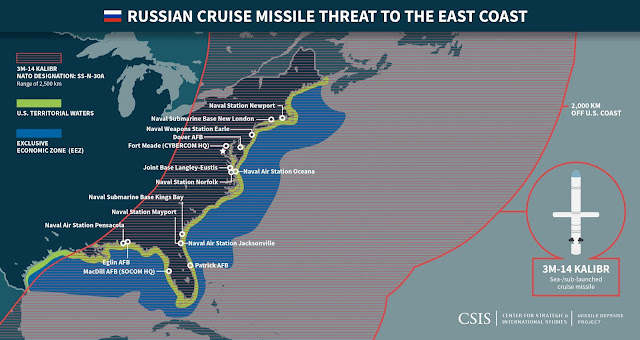
Russia announced recently that it plans to use vessels equipped with Kalibr cruise missiles for patrols in the western Atlantic Ocean. The use of these missiles are expected to be a new form of strategic deterrence which Russia hopes will restore the strategic balance  with the United States. During the Cold War, strategic patrols were conducted by submarines equipped with ballistic missiles. The use of such vessels was obvious as only SSBN submarines were able to mount a credible deterrent by striking the adversary from an unexpected location with as little warning as possible. The decline of the Russian navy in recent decades has greatly reduced Russia's ability  to mount these patrols and create a credible deterrence  against the United States. By using Kalibr class cruise missiles, Russia hopes to restore this balance.  These missiles are a more potent deterrent against the United States as it is more difficult to intercept compared to ballistic mis...

New hydrographic vessels to be build for Russian Navy

Image
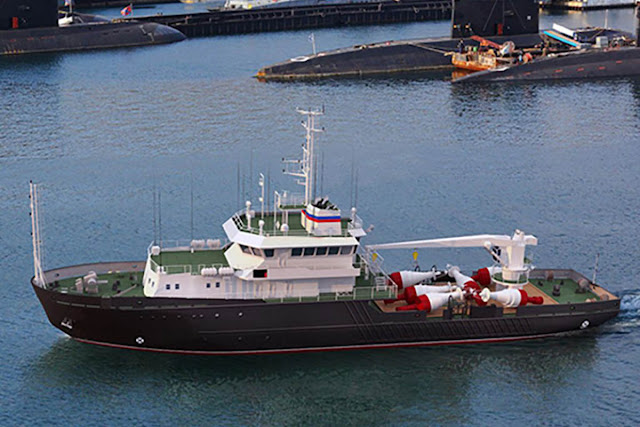
On January 2 the TASS news agency reported that nine new hydrographic vessels are to be built for the Russian Navy. According to the TASS news agency, the construction program is as follows: 'Two small Project 19910 vessels, two large Project 23040G hydrographic boats, two newest large Project 19920 hydrographic boats and three large Project 23370G large hydrographic boats will be built for the Russian Navy before 2021, the Russian Defense Ministry’s press service said on Wednesday. "The construction of two small Project 19910 hydrographic vessels is currently underway," the ministry said, adding that they would become part of the Russian Navy in 2019 and 2020 respectively. In addition, the Nizhegorodsky Teplokhod shipyard is working on two large Project 23040G hydrographic boats. The shipyard earlier completed the construction of two similar vessels for the Baltic Fleet. The Navy will get the new ships in 2019. Project 19910 hydrographic vessel Meanwhi...

Evolution of the Russian Navy in the near future

Image
As 2018 came to an end, three new naval ships were commissioned into the Russian Navy. On December 16 the Baltic Fleet commissioned the first of the Project 22800 guided missile corvette RFS Mytishchi. On December 20, the Black Sea Fleet commissioned the Project 22160 patrol ship RFS Vasily Bykov and on December 25 the Pacific Fleet commissioned RFS Gromkiy, the sixth ship of the Project 20380 Steregushchy class corvette. Tough this rapid pace of commissioning warships was more the result of coincidence instead of careful and deliberate planning, it nevertheless showed the current evolution of the Russian Navy as a whole. First, Russia is showing itself committed to modernize its fleets with large amounts of smaller but potent warships. The RFS Mytishchi is the first of a batch of 20 corvettes to be build while Project 22160 involves two batches of three patrol vessels. The Steregushchy class envisions a total of 24 ships to be build with the first batches to be build for the Balt...

Blak Sea Fleet conduct missile drills

Image
Units of the Russian Black Sea Fleet conducted several drills in the Crimea with BAL mobile launchers. The drills involved detecting surface targets in the Black Sea, providing target data and preparing the mobile launchers for delivering missile strikes. BAL mobile missile system The BAL missile system uses a rocket booster in order to launch a Zveda Kh-35 subsonic cruise missile which is designed to attack warships up to a tonnage of 5,000 tons. The missile itself uses an active radar homing to lock on to its target. The missile goes into a subsonic sea-skimming flight during its terminal approach in order to avoid radar detection for as long as possible. The Kh-35 is an all weather missile which can be used up to a sea state 5 to 6, both during the day and night. As such, the missile can be used a a wide variety of weather conditions and forms an almost permanent threat to ships entering its engagement zone. This missile itself has a range of 120km but this extended t...