Posts

Counter insurgency training for Caspian marines

Image
Units of the Caspian Flotilla Naval Infantry conducted a training exercise in the Dagastan region on March 26. A total of 1.000 military personnel and over 200 pieces of military equipment reportedly took part in this exercise. The exercise itself was centered on a reconnaissance and raiding operation against insurgent forces. The marines used motorized and mechanized units such as BTR-82A and MT-LB armored personnel carriers  while Mi-8 helicopters reportedly provided overhead support during the operation. Start of the ambush - source  https://tvzvezda.ru/ The marines were tasked with locating and engaging a group of insurgents in the mountainous and wooded terrain of the Dagastan region in the Caucasus. During the exercise, a group of soldiers, simulating the insurgents, ambushed and attacked a motorized column of BTR-82As transporting a company of marines in a mountain pass. The ambush started with a smoke grenade exploding near the road as the first BTR-82A passed ...
Laika class - use and purpose in the Russian Navy

Image
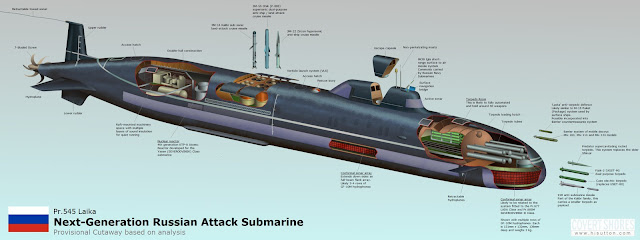
The project 545 Laika class nuclear attack submarine was first announced on a Russian Defense exhibition in December 2019. Although the submarine was not officially confirmed as the newest class in the Russian nuclear submarine fleet, many analysts have speculated over the use and purpose of the Laika class in the Russian Navy. The Laika class is speculated to be a cheaper alternative to the Project Pr.885/885M Severodvinsk class submarine (NATO reporting name ‘Yasen’). Rather than being a direct competitor to Severodvinsk class, the Laika class is considered to operate in conjunction with the Severodvinsk class. Being a cheaper brother to the Severodvinsk class, the Laika will most likely be used to replace the existing fleet of Russian nuclear attack submarines such as the Project 945 Barrakuda and Project 945A Kondor, (NATO reporting names 'Sierra I’ and ‘Sierra II’ respectively) and Project 971 Shchuka-B (Nato reporting name ‘Akula’) classes. Laika class submarine - imag...

Russia's capital shipbuilding restrictions

Image
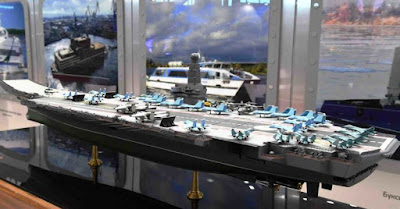
Whenever the Russian media shows scale models of potential aircraft carriers for the Russian Navy, a widespread debate starts about the use and purpose of these vessels by the Russian Navy. While these discussions have their rightful place, there is a general ignorance that the aircraft carrier debate is part of a larger discussion, namely that Russia has always been lagging in the construction and operation of capital ships. One simply has to look to the fact that Russian shipyards are currently not building larger vessels such as destroyers and cruisers. Indeed, all capital ships currently in use by the Russian Navy date back from the Soviet era and it is unlikely that the lack in capital ships will be resolved in the near future. Lamantin class carrier - scale model Historical perspective The lack of capital warships in the Russian navy can be traced back to the end of the tsarists empire. Having lost the majority of its capital ships first in the Battle of Tsushima in ...

Ocean Shield 2019 - After action report

Image
Exercise Ocean Shield 2019 (Okeanskiy Shchit 2019) was a large scale naval exercise conducted by the Baltic Fleet between August 1 and 9, 2019. The exercise involved the participation of over 49 warships from two seperate fleets, Northern and Baltic, with 20 support ships. Over 58 aircraft from both the army and naval aviation were involved as well. Russian figures state that a total of 10,634 military personnel were involved in the exercise. The exercise involved a wide variety of smaller exercises which will be discussed in further detail below in the form of daily reports followed by a general summary. The first focus of the exercise was to check the combat readiness of the Russian naval forces in the Baltic Sea and the further development of skills in operating the fleet and executing different tasks during this exercise. Several Russian sources state that lessons learned from naval deployments at the Syrian coast were also taken into account during the exercise. A lot of info...

Ocean going capabilities for Russian frigates

Image
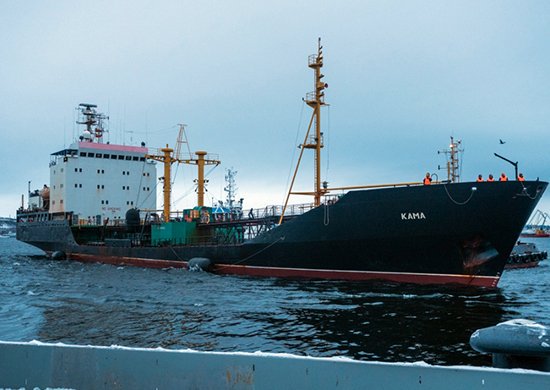
Northern Fleet frigate RFS Admiral Gorshov recently conducted a Replenishment at Sea (RAS) on the Atlantic Ocean. The RFS Gorshkov and her escorting group were transiting from Cuba towards her home base when the RAS took place. RAS is not considered to be a special maneuver and is a common practice for warships who operate for extended periods at sea. RAS allows warships to extend their duration at sea by taking on supplies from logistic vessels. During this operation, the RFS Gorshkov and her escorting ships took on fuel from the sea tanker RFS Kama. Northern Fleet light tanker RFS Kama Russian shipbuilding programs are currently focused on the construction of smaller warships such as frigates and corvettes. The smaller displacement of these warships also restricts the space available to store supplies such as food and fuel, lowering the time these ships can spend at sea. The only way these ships can extend their operational endurance at sea without returning back to port is ...

New destroyers for the Russian Navy?

Image
Russian news outlets reported on Thursday May 9 the existence of plans to build a new variant of the Project 22350 Admiral Gorshkov class frigates which are currently in service in the Russian Navy. The new variant is to increase in size to a water displacement of 7.000 tons, compared to the 4.500 tons of the current Admiral Gorshkov class. At the same time, the amount of missile launchers on board of the new variant is to increase to a total of 48 Vertical Launch System (VLS) cells, a significant increase compared to the current modern frigates that Russia is building. According to Russian media outlets, a total of 12 ships of this new variant are to be constructed with the first ship entering service in 2027. A finalization of the contract is expect by the end of 2019. Project 22350, commonly known as the Admiral Gorshkov class, is one of the few modern classes of frigates that Russia is currently building. The lead ship, RFS Admiral Gorshkov, has proven itself to be a capable f...