Posts

Airborne troops conduct amphibious landing at Crimea
Image
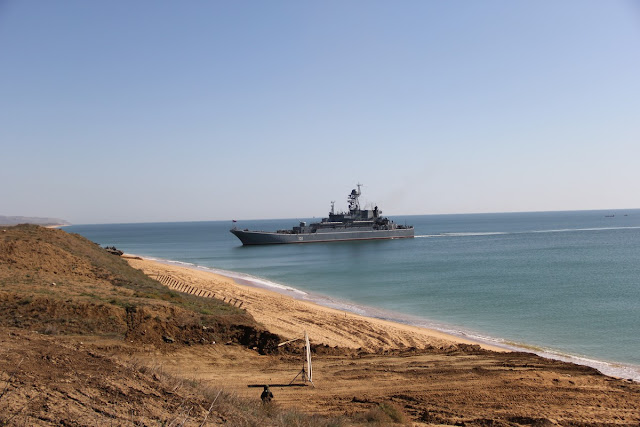
Units belonging to the 7th Guards Mountain Air Assault Division conducted an amphibious landing on the Opuk training ground at the Crimean Peninsula. The exercise was part of larger military maneuvers held by Russian airborne forces on the peninsula over the previous days. The fact that airborne units were used in a task which is traditionally assigned to Russian Naval Infantry suggests that Russia tested the interoperability of its ground forces against an enemy attack upon the Crimea Peninsula.  RFS Ceasar Kunikov approaching the Opuk training ground Around 400 airborne troops, supported by over 30 military vehicles, were transported to the Opuk training ground by two landing tank ships. Russian media identified these ships as the RFS Ceasar Kunikov and the RFS Azov. Both vessels are part of the Ropucha-class LST's, each capable of transporting up to 340 soldiers and a dozen armored vehicles. Following the initial landing operation, both ships conducted gunnery exercis...

Russia sets to improve the Ivan Gren-class

Image
Russia recently announced that it plans to build two more Ivan Gren-class ships for its navy. Both ships are reported to be upgraded versions of the current RFS Ivan Gren, the sole ship of its class. The upgrades were not specified but are to be made in the fields of ship maneuverability, readiness during sea transit, crew habitability and the ergonomics of the ship. RFS Ivan Gren Landing Ship Tank Though details of the upgrades are unknown, the identified fields give us an insight of the next two Russian amphibious assault ships. First, there is no evidence to suggest that the Ivan Gren-class will undergo significant structural changes. The ship is designed to be a landing tank ship capable of carrying 13 main battle tanks or 36 armored personnel carriers and transport around 300 marines. The transport capacity and her capabilities of landing these troops (through beaching herself and opening her bow doors) are expected to remain. The upgrades are more to be expected to...

Russia reinforces Baltic positions with new troops

Image
Russia announced on Wednesday February 27 that it will set up a tank regiment and a coastal defense missile battalion in the Baltic region. The deployment is scheduled to be completed in 2019 but no specific time frame was brought forward. Both military formations are to be attached to the Russian Baltic Fleet. Although the location of the deployment was not mentioned by name, it is expected that both military formations will be stationed in the Kaliningrad Region. By stationing these formations in the Kaliningrad Region, Russia further strengthens its position in the Baltic Region. Kaliningrad is geographically isolated from the Russian mainland and effectively surrounded by NATO forces. The increasing in military formations in the Baltic Region allows Russia to defend its positions in this region to a higher degree. At the same time, the deployment follows the pattern of Russia using the Kaliningrad Region as a heavily defended bastion in the same way the Soviet Union defe...

Baltic Fleet Aviation conducts training at Kaliningrad

Image
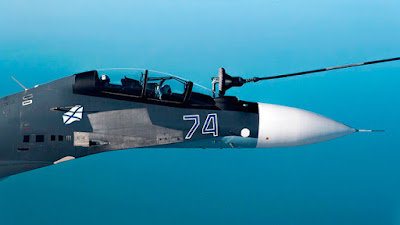
Aircraft of the Baltic Fleet conducted air training operations in the Kaliningrad Region on Tuesday February 29. The training was conducted by by Su-30SM and Su-24M aircraft and involved training in air to air refueling from a IL-78 tanker aircraft. A total of 15 aircraft participated in this training over the course of several days. The air-to-air refueling training was conducted both day and night and pilots conducted these exercises both while flying single or as a pair. Air-to-air refueling is considered to be a stressful event as the pilot of the receiving aircraft needs to focus himself during the approach and make a successful connection. The pilot also needs to be focused in order to maintaining position and speed during the transfer of fuel. By conducting these training, the Baltic Fleet Aviation makes sure that its pilots maintain the necessary skills needed to perform air-to-air refueling under a wide range of conditions. Air-to-air refueling allows Russian aviation...

Russia deploys naval infantry aboard warships

Image
Russia recently announced that it plans to deploy small detachments of naval infantry on board of its warships. These small detachments are called anti-terrorist group by the Russian media and are expected to join warships deploying in conflict zones in the Middle East, Southeast Asia and Africa. Though the deployment of naval infantry on board of warships is nothing new, for Russia it marks a change o policy. The previous policy dates back from the Soviet Union when naval infantry was deployed on warships between the 1960s and 1991. Russian naval infantry during exercise The deployment of the anti-terrorist groups makes sense and Russia is actually following the standard practices of naval infantry forces in western Europe. Just as their western counterparts embarked aboard, the anti-terrorist groups are expected to be able to combat on board of ships, provide harbor protection in conflict zones and be able to board and search ships. These practices are not strange to the R...

Russia deploys cruise missiles in western Atlantic

Image
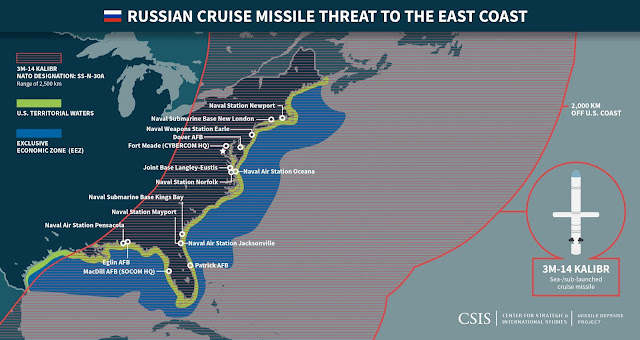
Russia announced recently that it plans to use vessels equipped with Kalibr cruise missiles for patrols in the western Atlantic Ocean. The use of these missiles are expected to be a new form of strategic deterrence which Russia hopes will restore the strategic balance  with the United States. During the Cold War, strategic patrols were conducted by submarines equipped with ballistic missiles. The use of such vessels was obvious as only SSBN submarines were able to mount a credible deterrent by striking the adversary from an unexpected location with as little warning as possible. The decline of the Russian navy in recent decades has greatly reduced Russia's ability  to mount these patrols and create a credible deterrence  against the United States. By using Kalibr class cruise missiles, Russia hopes to restore this balance.  These missiles are a more potent deterrent against the United States as it is more difficult to intercept compared to ballistic mis...

New hydrographic vessels to be build for Russian Navy

Image
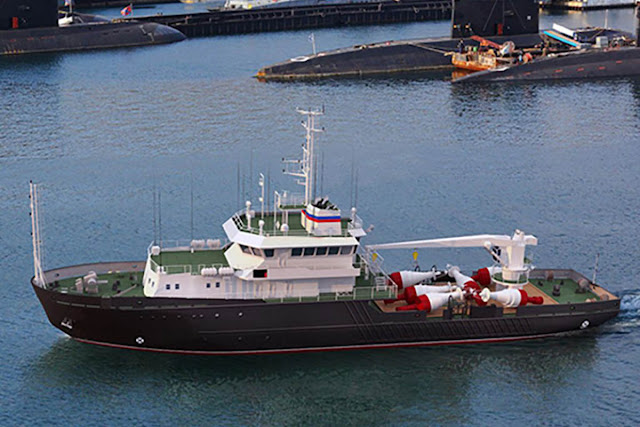
On January 2 the TASS news agency reported that nine new hydrographic vessels are to be built for the Russian Navy. According to the TASS news agency, the construction program is as follows: 'Two small Project 19910 vessels, two large Project 23040G hydrographic boats, two newest large Project 19920 hydrographic boats and three large Project 23370G large hydrographic boats will be built for the Russian Navy before 2021, the Russian Defense Ministry’s press service said on Wednesday. "The construction of two small Project 19910 hydrographic vessels is currently underway," the ministry said, adding that they would become part of the Russian Navy in 2019 and 2020 respectively. In addition, the Nizhegorodsky Teplokhod shipyard is working on two large Project 23040G hydrographic boats. The shipyard earlier completed the construction of two similar vessels for the Baltic Fleet. The Navy will get the new ships in 2019. Project 19910 hydrographic vessel Meanwhi...